RESEARCH OVERVIEW
What is BPC-157?
BPC-157, short for Body Protection Compound-157, is a synthetic peptide containing 15 amino acids. It is associated in the literature with a gastric-protein-derived sequence and is investigated in experimental tissue-response models. The main research questions concern cell migration, tendon biology, vascular responses and growth-factor signalling—not an established ability of a research vial to heal an injury.
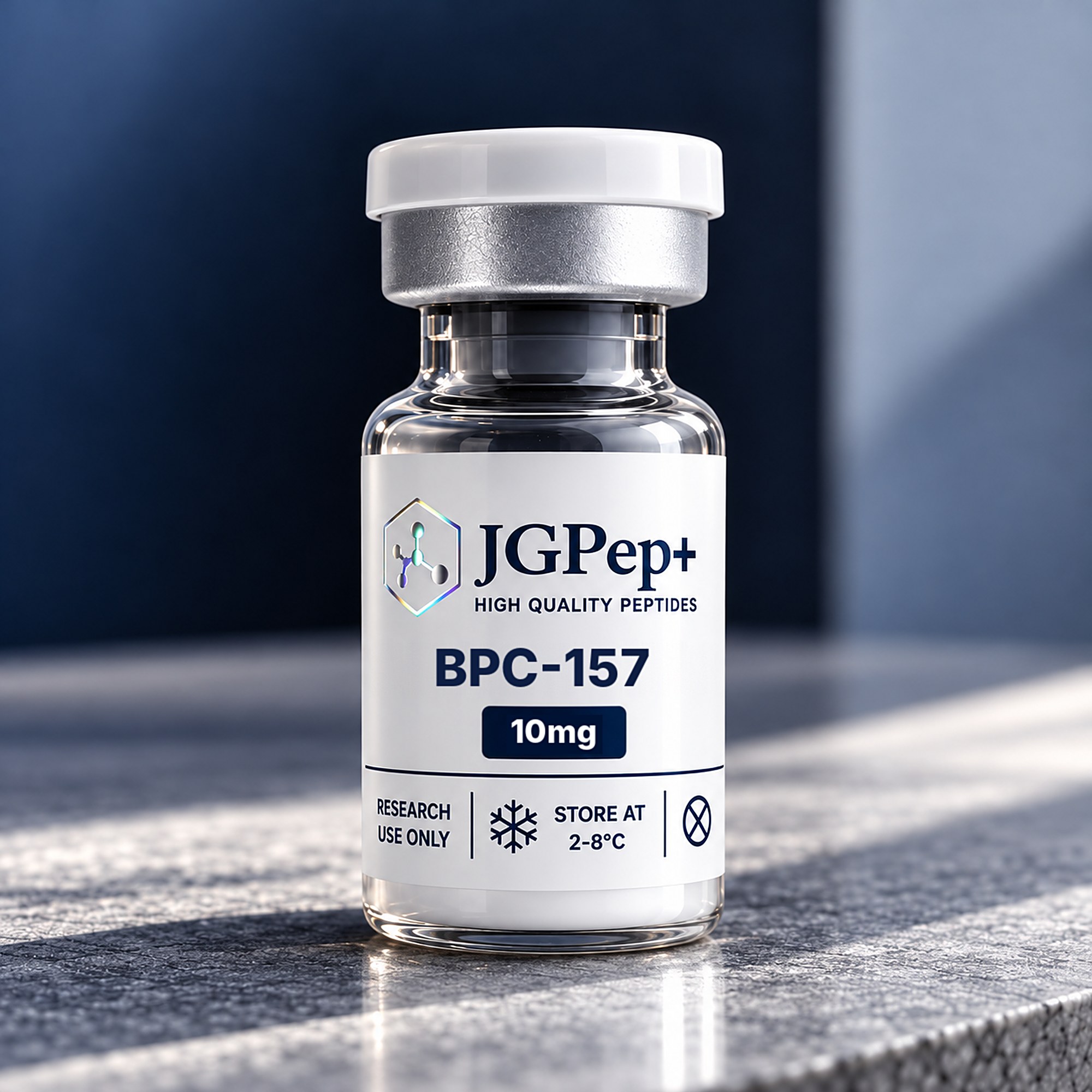
BPC-157 10 mg — product details
This listing is for BPC-157 10 mg, product code JG-MIG-017. The 10 mg figure is the listed material quantity, not a recommended dose or a concentration. Review this strength’s label and matching batch record when planning a laboratory assay.
LISTED CONTENT
10 mg
PRODUCT CODE
JG-MIG-017
INTENDED USE
Laboratory research
Research focus and areas of interest
Tendon cells and repair-related signalling
In rat tendon explants and cultured fibroblasts, investigators measured cell outgrowth, migration, survival under oxidative stress and FAK–paxillin signalling. One study did not find a direct increase in fibroblast proliferation, an important distinction from a broad claim that BPC-157 simply “grows new tissue”. [1]
Growth-factor and vascular research
Separate work examined growth-hormone-receptor expression in tendon fibroblasts. Rat injury studies also evaluated blood-vessel formation, inflammatory markers and biomechanical recovery. These are different experimental endpoints; a change in one does not establish complete tissue regeneration or a clinical outcome. [2]
Interpreting the experimental models
Transected-tendon experiments and earlier wound models provide hypotheses about tissue adaptation. Their species, injury methods and outcome measures matter when assessing relevance. The linked papers should be read in full rather than treating their titles as proof of a benefit in people. [3]
Evidence and limitations
The five references below chiefly concern laboratory and rat models. They do not establish a human treatment protocol, universal bioavailability, long-term safety or the performance of this JGPEP+ batch. Resistance to breakdown in one experimental setting would not establish stability in every solvent, temperature or formulation.
Scientific references describe the material and methods used by their authors. They do not certify this product’s purity, sterility, identity or suitability for a particular experiment. A related analogue, delivery system or combination is not automatically equivalent to the supplied peptide.
Technical identity and documentation
Literature identity: pentadecapeptide; reported single-letter sequence GEPPPGKPADDAGLV. Sequence identity in a paper is not a batch certificate. Confirm the supplied salt or counterion, analytical identity and actual content using matching documentation.
For this product’s identity and batch results, visit the COA and documentation page or contact JGPEP+ with the product and batch numbers. Literature values should not replace a matching analytical certificate.
Storage and laboratory handling
Follow the product label and batch-specific supplier instructions. Confirm temperature, solvent compatibility, stability and any reconstitution requirements before use. Storage conditions reported for another supplier or a clinical formulation should not be applied automatically to this material.
Research references
Original studies and analytical papers are linked below. Study type is included so that laboratory models, clinical research and related-analogue evidence can be distinguished.
1. Rat tendon-cell migration and signalling. Chang CH et al. 2011 Mar. Journal of applied physiology (Bethesda, Md. : 1985). Cell and ex vivo study. PubMed PMID 21030672 · Publisher / DOI
2. Growth-hormone-receptor expression in tendon cells. Chang CH et al. 2014 Nov 19. Molecules (Basel, Switzerland). Cell study. PubMed PMID 25415472 · Publisher / DOI
3. Rat Achilles-tendon injury model. Staresinic M et al. 2003 Nov. Journal of orthopaedic research : official publication of the Orthopaedic Research Society. Animal and cell study. PubMed PMID 14554208 · Publisher / DOI
4. Early vascular and inflammatory responses in rats. Krivic A et al. 2008 May. Inflammation research : official journal of the European Histamine Research Society … [et al.]. Animal study. PubMed PMID 18594781 · Publisher / DOI
5. Experimental wound and angiogenesis models. Seiwerth S et al. 1997 May-Oct. Journal of physiology, Paris. Animal study. PubMed PMID 9403790 · Publisher / DOI
For laboratory research only. Not for human or veterinary consumption or administration. This information is scientific background, not medical advice or an administration guide.

Reviews
There are no reviews yet.