RESEARCH OVERVIEW
What is GHK-Cu?
GHK-Cu is a copper complex of the tripeptide glycyl-L-histidyl-L-lysine. Research examines its coordination chemistry and responses in skin-cell, inflammatory and tissue-model systems. The copper-bound complex should be distinguished from uncomplexed GHK and from preparations with different counterions or delivery materials.
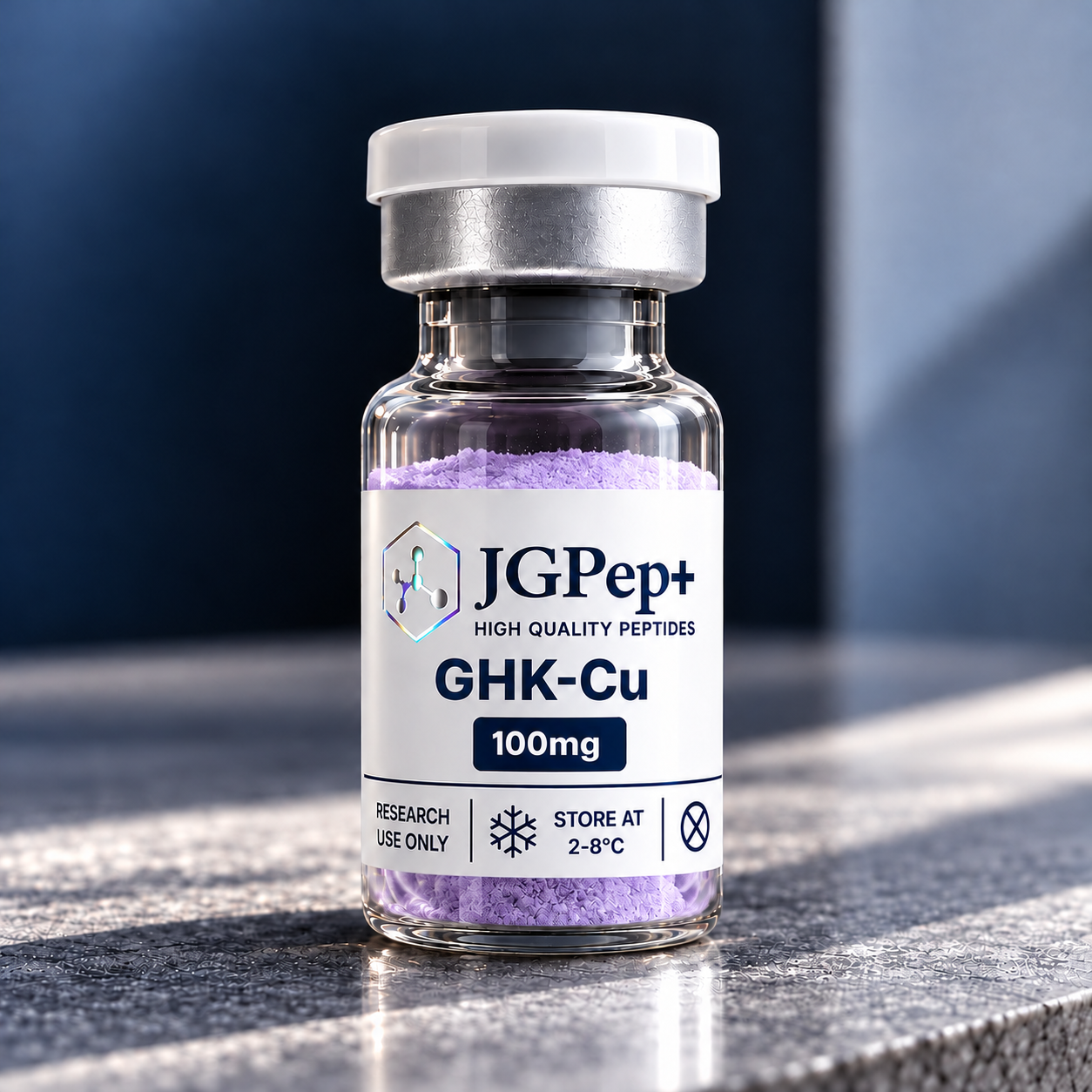
GHK-Cu 100 mg — product details
This listing is for GHK-Cu 100 mg, product code JG-MIG-021. The 100 mg figure is the listed material quantity, not a recommended dose or a concentration. Review this strength’s label and matching batch record when planning a laboratory assay.
LISTED CONTENT
100 mg
PRODUCT CODE
JG-MIG-021
INTENDED USE
Laboratory research
Research focus and areas of interest
Skin-cell and adhesion research
Keratinocyte and reconstructed-skin experiments evaluated proliferation-related markers, integrins and p63 expression after exposure to copper-GHK. These results concern specified cell systems and experimental conditions, not a clinical conclusion about cosmetic rejuvenation or wound treatment. [1]
Penetration and delivery systems
An ex vivo skin study measured copper retention and passage through isolated tissue layers. Separately, researchers incorporated GHK-Cu into a composite hydrogel. The chemical form, tissue preparation and carrier influence such results and should be considered part of the experimental material. [2]
Inflammatory and oxidative-stress pathways
Mouse and cell models have investigated inflammatory signalling, reactive-oxygen measurements and SIRT1-related muscle responses. These studies support mechanistic questions about the copper-peptide complex, but they do not establish that all proposed pathways occur in every tissue or formulation. [4]
Evidence and limitations
The linked evidence includes cell models, ex vivo tissue and animal experiments. It does not certify anti-ageing, skin-repair or systemic health effects for this research product. A hydrogel’s results are formulation-specific, and copper measurements do not by themselves prove intact-peptide transport.
Scientific references describe the material and methods used by their authors. They do not certify this product’s purity, sterility, identity or suitability for a particular experiment. A related analogue, delivery system or combination is not automatically equivalent to the supplied peptide.
Technical identity and documentation
Literature identity: GHK coordinated with copper(II). Confirm complex identity, copper content, counterion and analytical method in the batch documentation. Do not treat unbound GHK or another copper-tripeptide complex as an equivalent material without justification.
For this product’s identity and batch results, visit the COA and documentation page or contact JGPEP+ with the product and batch numbers. Literature values should not replace a matching analytical certificate.
Other listed quantities
These are separate catalogue quantities, not a dosing ladder. The research literature concerns the peptide or specified study formulation rather than a claim that one catalogue strength is more effective.
Storage and laboratory handling
Follow the product label and batch-specific supplier instructions. Confirm temperature, solvent compatibility, stability and any reconstitution requirements before use. Storage conditions reported for another supplier or a clinical formulation should not be applied automatically to this material.
Research references
Original studies and analytical papers are linked below. Study type is included so that laboratory models, clinical research and related-analogue evidence can be distinguished.
1. Keratinocyte and skin-equivalent responses. Kang YA et al. 2009 Apr. Archives of dermatological research. Cell and reconstructed-tissue study. PubMed PMID 19319546 · Publisher / DOI
2. Copper retention and penetration in isolated skin. Hostynek JJ et al. 2010 Nov. Inflammation research : official journal of the European Histamine Research Society … [et al.]. Ex vivo tissue study. PubMed PMID 20703511 · Publisher / DOI
3. Composite hydrogel incorporating GHK-Cu. Chen H et al. 2025. Biomaterials research. Engineered formulation study. PubMed PMID 39902373 · Publisher / DOI
4. SIRT1-related muscle experiments. Deng M et al. 2023 Jun. Journal of cachexia, sarcopenia and muscle. Cell and animal study with human observations. PubMed PMID 36905132 · Publisher / DOI
5. Inflammatory lung models involving GHK-Cu. Park JR et al. 2016 Sep 6. Oncotarget. Cell and animal study. PubMed PMID 27517151 · Publisher / DOI
For laboratory research only. Not for human or veterinary consumption or administration. This information is scientific background, not medical advice or an administration guide.

Reviews
There are no reviews yet.