RESEARCH OVERVIEW
What is Melanotan II?
Melanotan II is a cyclic melanocortin-peptide analogue used in receptor and physiological research. Its structure differs from the parent α-melanocyte-stimulating hormone and from related compounds such as bremelanotide. Research spans receptor selectivity, experimental neural pathways and small early human studies.
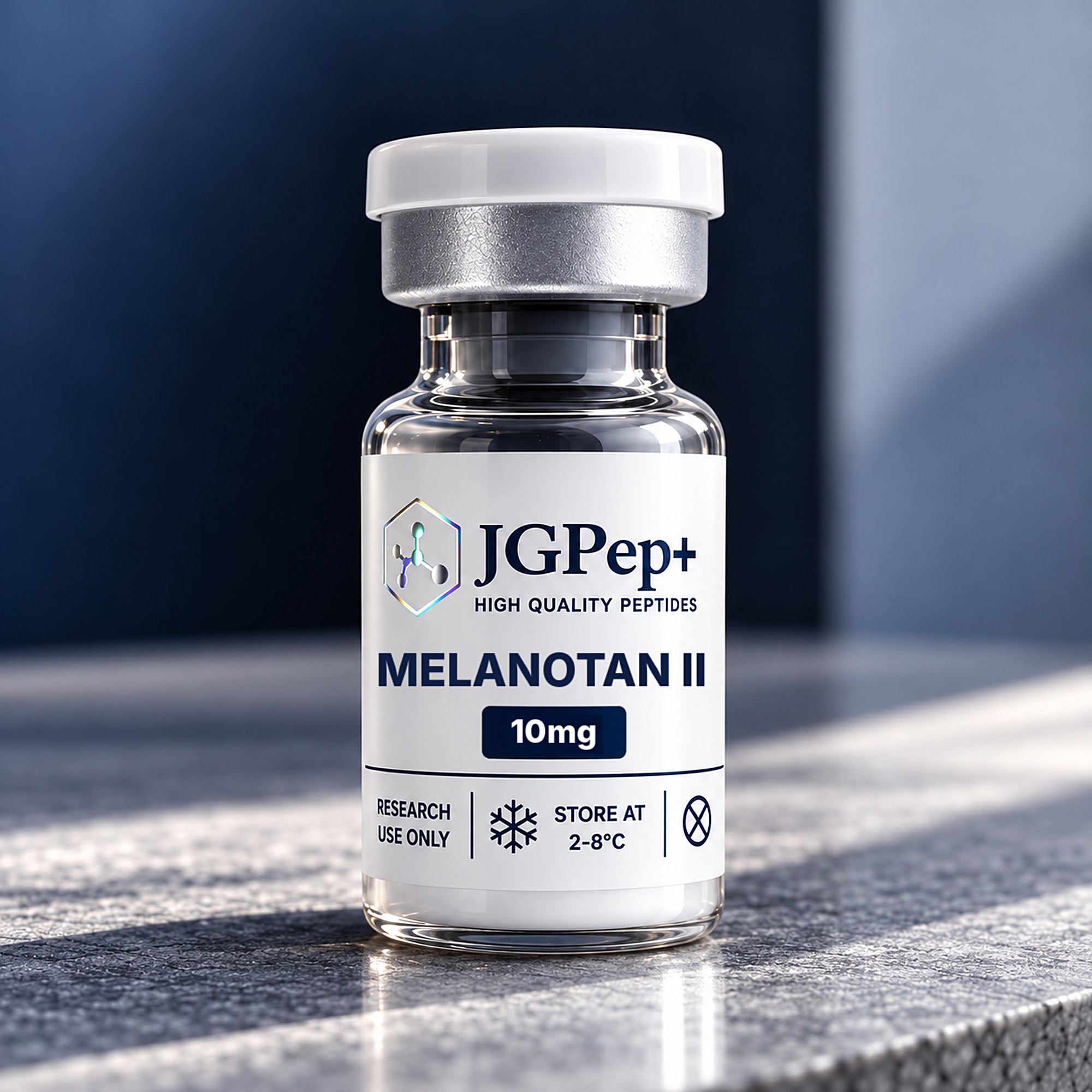
Melanotan II 10 mg — product details
This listing is for Melanotan II 10 mg, product code JG-MIG-034. The 10 mg figure is the listed material quantity, not a recommended dose or a concentration. Review this strength’s label and matching batch record when planning a laboratory assay.
LISTED CONTENT
10 mg
PRODUCT CODE
JG-MIG-034
INTENDED USE
Laboratory research
Research focus and areas of interest
Peptide structure and receptor selectivity
Medicinal-chemistry work modified the cyclisation strategy of Melanotan II to explore how molecular conformation affects receptor affinity and functional selectivity. Results from newly designed analogues should not be described as properties shared by every melanocortin peptide. [2]
Animal and receptor-model experiments
Zebrafish and mouse studies investigated behavioural or receptor-associated endpoints. These are experimental models, not proof of cognitive, developmental or metabolic benefits in people. The species and model design need to remain visible when summarising findings. [3]
Early human pharmacology
The early phase-I study involved only three volunteers and recorded physiological effects and adverse responses. Its small size is a major limitation. It cannot establish broad safety, long-term outcomes or suitability for unmonitored personal use. [1]
Evidence and limitations
This selection mixes medicinal chemistry, animal models and a very small early clinical study. It does not support tanning instructions, a consumer safety claim or use of a research product as a medicine. Related receptor-rescue experiments are mechanistic context.
Scientific references describe the material and methods used by their authors. They do not certify this product’s purity, sterility, identity or suitability for a particular experiment. A related analogue, delivery system or combination is not automatically equivalent to the supplied peptide.
Technical identity and documentation
Literature identity: a cyclic heptapeptide melanocortin analogue. Confirm the exact cyclisation, terminal modifications, counterion and batch identity. Melanotan II and PT-141 are related but distinct compounds.
For this product’s identity and batch results, visit the COA and documentation page or contact JGPEP+ with the product and batch numbers. Literature values should not replace a matching analytical certificate.
Storage and laboratory handling
Follow the product label and batch-specific supplier instructions. Confirm temperature, solvent compatibility, stability and any reconstitution requirements before use. Storage conditions reported for another supplier or a clinical formulation should not be applied automatically to this material.
Research references
Original studies and analytical papers are linked below. Study type is included so that laboratory models, clinical research and related-analogue evidence can be distinguished.
1. Small early human pharmacology study. Dorr RT et al. 1996. Life sciences. Small phase-I clinical study. PubMed PMID 8637402 · Publisher / DOI
2. Cyclisation and melanocortin-receptor selectivity. Tomassi S et al. 2022 Mar 10. Journal of medicinal chemistry. Medicinal-chemistry and receptor study. PubMed PMID 35188390 · Publisher / DOI
3. Zebrafish behavioural research. Wekwejt P et al. 2023 Sep. Biomedicine & pharmacotherapy = Biomedecine & pharmacotherapie. Animal study. PubMed PMID 37478579 · Publisher / DOI
4. Maternal-immune-activation mouse model. Minakova E et al. 2019. PloS one. Animal study. PubMed PMID 30629642 · Publisher / DOI
5. Humanised receptor model and pharmacological chaperones. René P et al. 2021 Feb 22. JCI insight. Related receptor-mechanism animal study. PubMed PMID 33434184 · Publisher / DOI
For laboratory research only. Not for human or veterinary consumption or administration. This information is scientific background, not medical advice or an administration guide.

Reviews
There are no reviews yet.