
RESEARCH OVERVIEW
What is MOTS-c?
MOTS-c is a 16-amino-acid mitochondrial-derived peptide described in research on communication between mitochondria and the cell nucleus. Its name refers to an open reading frame associated with mitochondrial 12S ribosomal RNA. Published experiments investigate metabolic signalling, responses to cellular stress and skeletal-muscle biology.
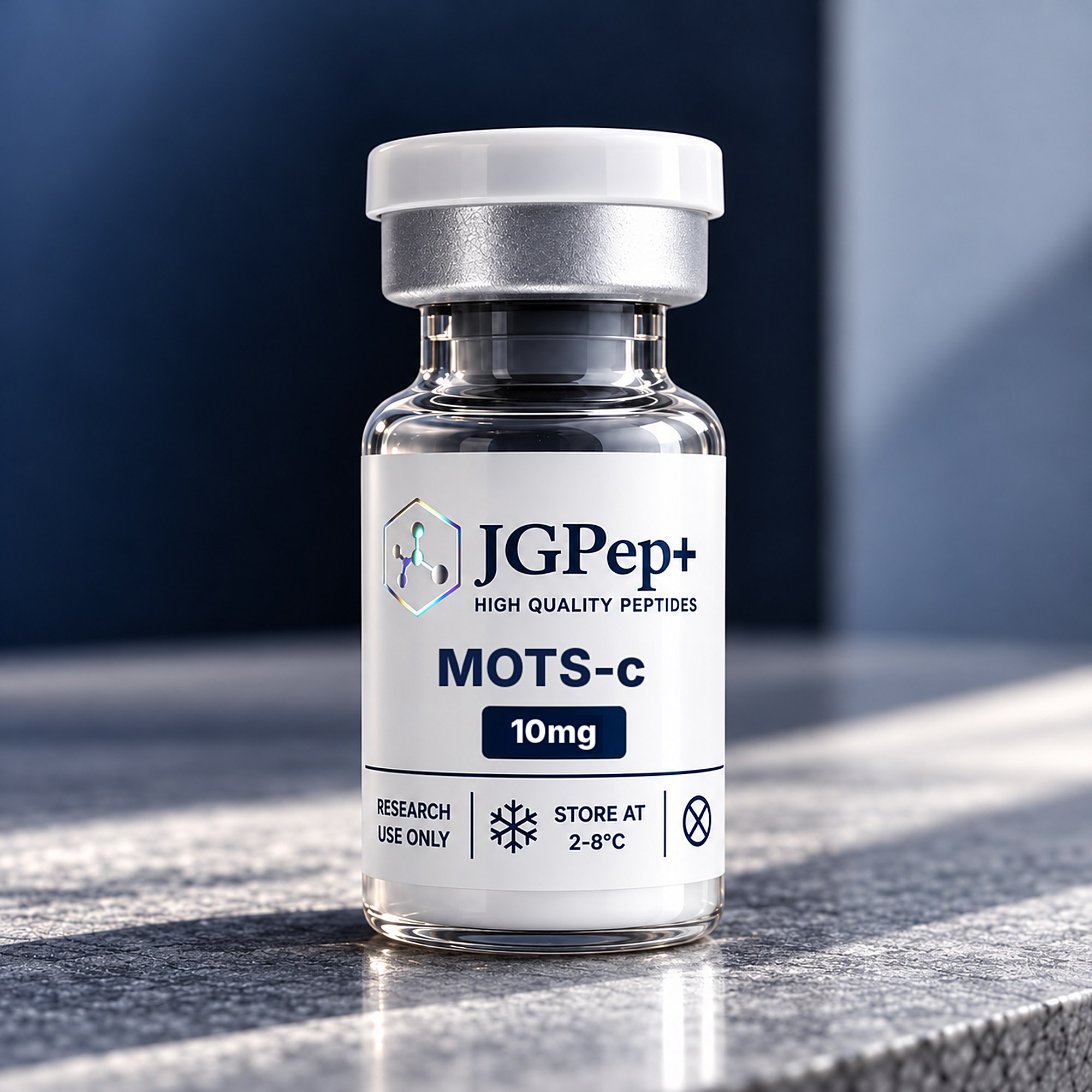
MOTS-c 10 mg — product details
This listing is for MOTS-c 10 mg, product code JG-MIG-023. The 10 mg figure is the listed material quantity, not a recommended dose or a concentration. Review this strength’s label and matching batch record when planning a laboratory assay.
LISTED CONTENT
10 mg
PRODUCT CODE
JG-MIG-023
INTENDED USE
Laboratory research
Research focus and areas of interest
Metabolic signalling
The discovery study connected MOTS-c with folate-cycle and purine-metabolism changes, AMPK signalling and metabolic endpoints in experimental systems. These findings made mitochondrial peptides a useful subject for studying how cells coordinate energy status and biochemical responses. [1]
Mitochondrial–nuclear communication
Cell experiments reported movement of MOTS-c into the nucleus during metabolic stress and changes in stress-responsive gene regulation. This is a mechanistic question about where a peptide acts and which pathways respond; it does not demonstrate a general anti-ageing effect in people. [2]
Muscle and metabolic models
Further work examined myoblast differentiation in vitro, muscle homeostasis and physical performance in mice, and metabolomic profiles in diet-induced-obesity models. These experiments use distinct endpoints, so results should be interpreted by model rather than merged into a single performance claim. [3]
Evidence and limitations
Cell studies and animal interventions do not establish that this product improves exercise performance, reverses ageing or treats metabolic disease in people. Measurements of naturally occurring MOTS-c during exercise must also be distinguished from studies administering an external preparation.
Scientific references describe the material and methods used by their authors. They do not certify this product’s purity, sterility, identity or suitability for a particular experiment. A related analogue, delivery system or combination is not automatically equivalent to the supplied peptide.
Technical identity and documentation
Literature identity: a mitochondrial-derived peptide of 16 amino acids. For experimental planning, confirm sequence, chemical form and batch identity; do not infer purity, sterility or suitability for a particular assay from the peptide name alone.
For this product’s identity and batch results, visit the COA and documentation page or contact JGPEP+ with the product and batch numbers. Literature values should not replace a matching analytical certificate.
Other listed quantities
These are separate catalogue quantities, not a dosing ladder. The research literature concerns the peptide or specified study formulation rather than a claim that one catalogue strength is more effective.
Storage and laboratory handling
Follow the product label and batch-specific supplier instructions. Confirm temperature, solvent compatibility, stability and any reconstitution requirements before use. Storage conditions reported for another supplier or a clinical formulation should not be applied automatically to this material.
Research references
Original studies and analytical papers are linked below. Study type is included so that laboratory models, clinical research and related-analogue evidence can be distinguished.
1. Discovery and experimental metabolic signalling. Lee C et al. 2015 Mar 3. Cell metabolism. Cell and animal study. PubMed PMID 25738459 · Publisher / DOI
2. Stress-responsive mitochondrial–nuclear communication. Kim KH et al. 2018 Sep 4. Cell metabolism. Cell-mechanism study. PubMed PMID 29983246 · Publisher / DOI
3. Muscle homeostasis and age-related mouse experiments. Reynolds JC et al. 2021 Jan 20. Nature communications. Human exercise observations and animal experiments. PubMed PMID 33473109 · Publisher / DOI
4. Myoblast differentiation in vitro. García-Benlloch S et al. 2022 Sep. Peptides. Cell study. PubMed PMID 35842023 · Publisher / DOI
5. Metabolomic responses in an obesity model. Kim SJ et al. 2019 Jul. Physiological reports. Animal metabolomics study. PubMed PMID 31293078 · Publisher / DOI
For laboratory research only. Not for human or veterinary consumption or administration. This information is scientific background, not medical advice or an administration guide.

Reviews
There are no reviews yet.