
RESEARCH OVERVIEW
What is Retatrutide?
Retatrutide is a peptide investigated for activity at GIP, GLP-1 and glucagon receptors. Research asks how combined receptor engagement relates to endocrine and metabolic responses. Its clinical-development papers concern controlled study formulations and do not establish the properties or suitability of this laboratory research material.
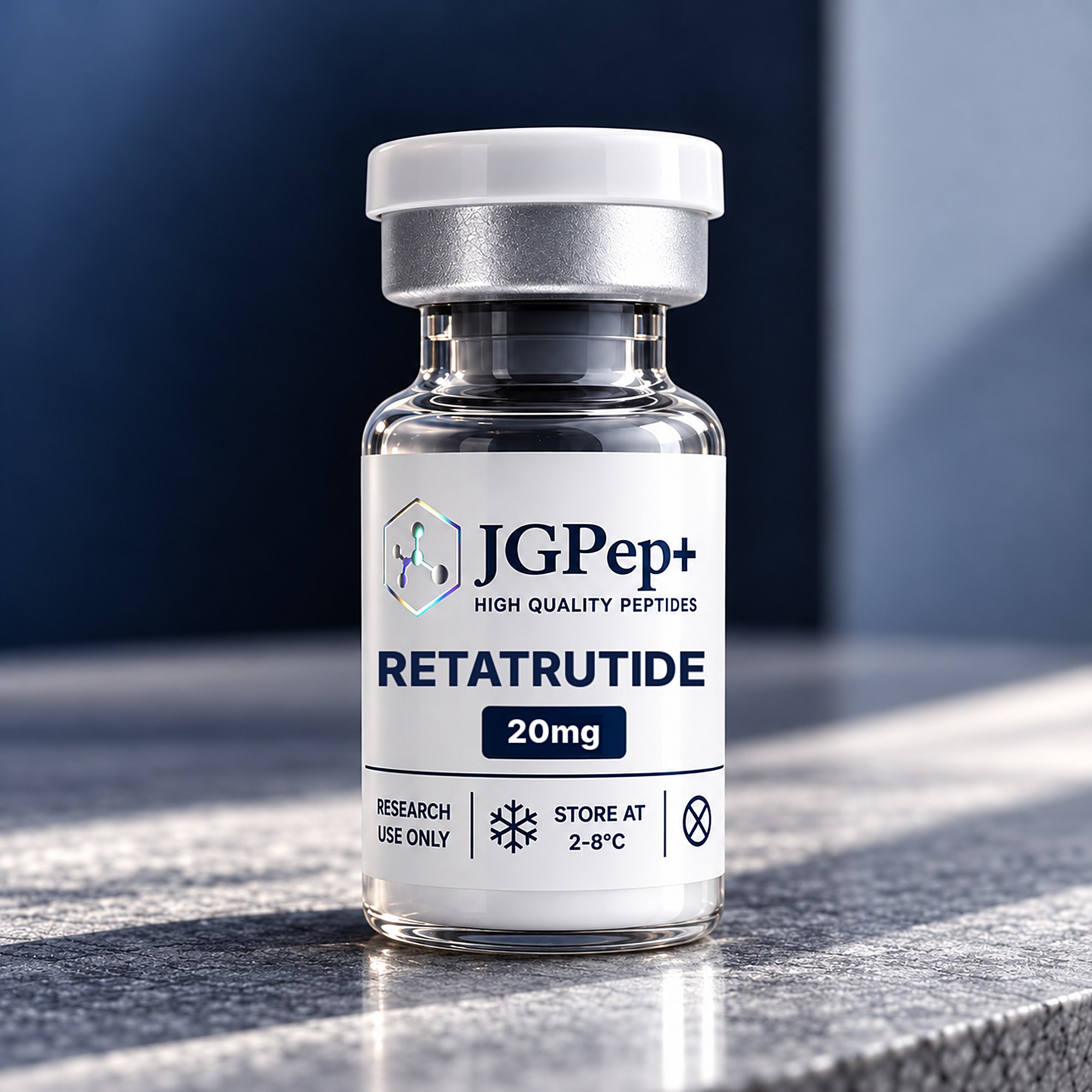
Retatrutide 20 mg — product details
This listing is for Retatrutide 20 mg, product code JG-MIG-012. The 20 mg figure is the listed material quantity, not a recommended dose or a concentration. Review this strength’s label and matching batch record when planning a laboratory assay.
LISTED CONTENT
20 mg
PRODUCT CODE
JG-MIG-012
INTENDED USE
Laboratory research
Research focus and areas of interest
Multi-receptor research
The three-receptor approach is central to retatrutide’s research identity. Clinical studies examine outcomes from combined receptor activity; they do not by themselves isolate which receptor produced an individual result or establish that every triple-agonist compound behaves similarly. [1]
Study populations and outcomes
Trials have evaluated defined groups with obesity or type 2 diabetes. Different populations, comparators, follow-up durations and statistical methods affect interpretation. It is more accurate to identify the trial and its population than to make a universal statement about weight or glucose outcomes. [2]
Liver and body-composition analyses
A liver-focused trial and a body-composition substudy assessed additional endpoints. A substudy is not necessarily an independent replication, and a change in body weight is not interchangeable with a measurement of fat distribution or liver biology. [3]
Evidence and limitations
The references include clinical trials and secondary analyses through the cited publication dates. They do not establish that a research vial reproduces a clinical preparation’s quality, exposure, safety or outcomes. No study regimen should be inferred from a catalogue quantity.
Scientific references describe the material and methods used by their authors. They do not certify this product’s purity, sterility, identity or suitability for a particular experiment. A related analogue, delivery system or combination is not automatically equivalent to the supplied peptide.
Technical identity and documentation
Literature identity: retatrutide, a multi-receptor peptide agonist. Confirm the complete chemical identity, modifications, counterion and batch-specific analytical record before using the material in an assay.
For this product’s identity and batch results, visit the COA and documentation page or contact JGPEP+ with the product and batch numbers. Literature values should not replace a matching analytical certificate.
Other listed quantities
Retatrutide 40 mg · Retatrutide 30 mg · Retatrutide 15 mg · Retatrutide 10 mg · Retatrutide 5 mg
These are separate catalogue quantities, not a dosing ladder. The research literature concerns the peptide or specified study formulation rather than a claim that one catalogue strength is more effective.
Storage and laboratory handling
Follow the product label and batch-specific supplier instructions. Confirm temperature, solvent compatibility, stability and any reconstitution requirements before use. Storage conditions reported for another supplier or a clinical formulation should not be applied automatically to this material.
Research references
Original studies and analytical papers are linked below. Study type is included so that laboratory models, clinical research and related-analogue evidence can be distinguished.
1. Phase-2 triple-receptor clinical research. Jastreboff AM et al. 2023 Aug 10. The New England journal of medicine. Randomised clinical trial. PubMed PMID 37366315 · Publisher / DOI
2. Controlled type-2-diabetes study. Rosenstock J et al. 2023 Aug 12. Lancet (London, England). Randomised clinical trial. PubMed PMID 37385280 · Publisher / DOI
3. Liver-focused phase-2a investigation. Sanyal AJ et al. 2024 Jul. Nature medicine. Randomised clinical trial. PubMed PMID 38858523 · Publisher / DOI
4. Body-composition substudy. Coskun T et al. 2025 Aug. The lancet. Diabetes & endocrinology. Secondary clinical-trial analysis. PubMed PMID 40609566 · Publisher / DOI
5. Later type-2-diabetes trial. Bajaj HS et al. 2026 Jun 13. Lancet (London, England). Randomised clinical trial. PubMed PMID 42250575 · Publisher / DOI
6. Later obesity and associated-endpoint trial. Jastreboff AM et al. 2026 Sep 29. The New England journal of medicine. Randomised clinical trial. PubMed PMID 42814954 · Publisher / DOI
For laboratory research only. Not for human or veterinary consumption or administration. This information is scientific background, not medical advice or an administration guide.


Reviews
There are no reviews yet.