
RESEARCH OVERVIEW
What is Selank?
Selank is a synthetic tuftsin-related peptide investigated in experimental neurobiology and stress-response research. Studies include neuronal-cell gene expression, rat-brain transcriptional responses and behavioural models. The evidence addresses particular experimental questions rather than establishing a general anxiety treatment or cognitive-enhancement claim for a research product.
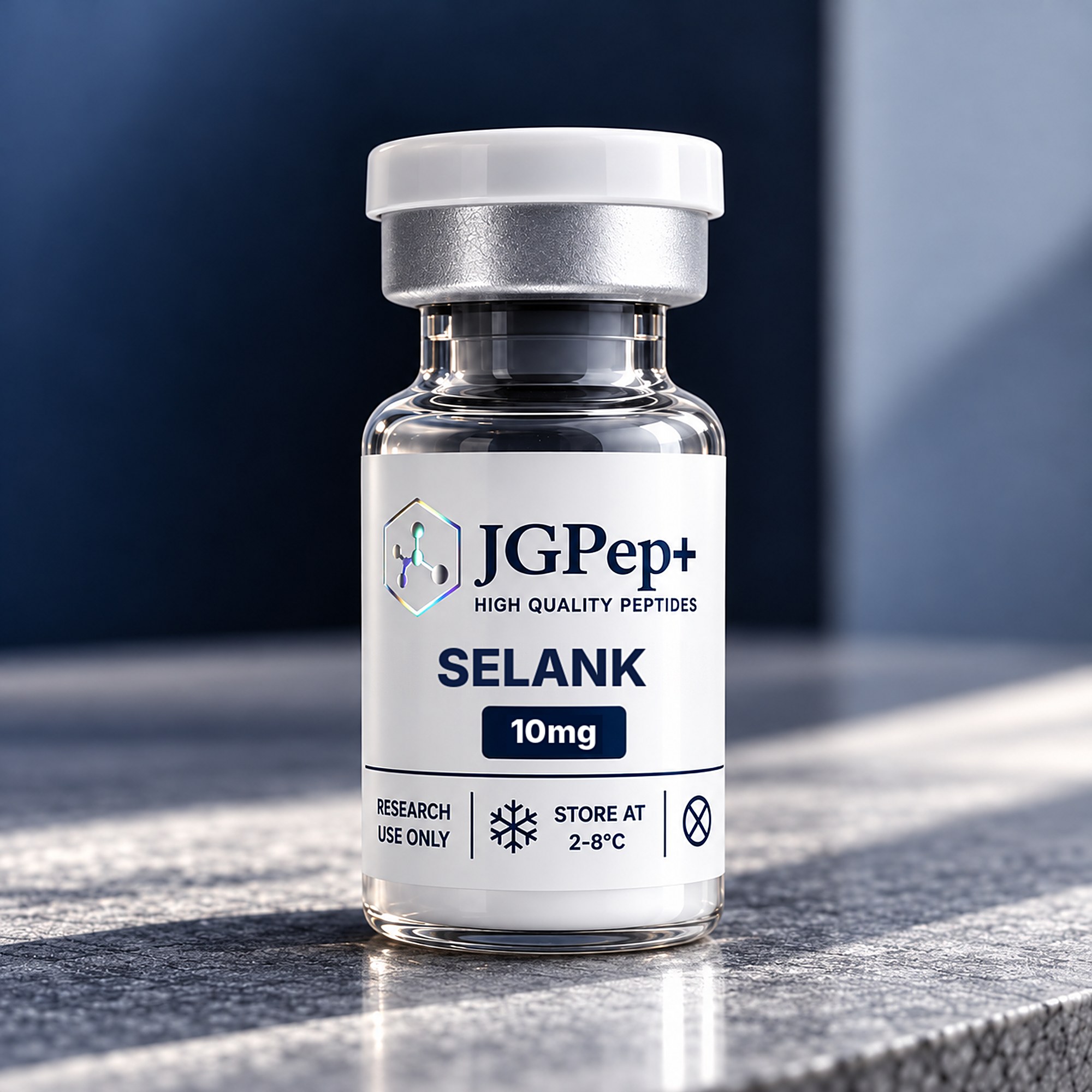
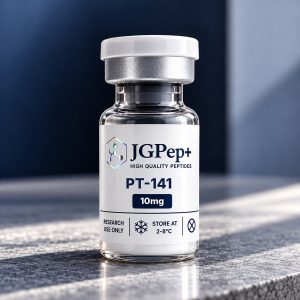
Selank 10 mg — product details
This listing is for Selank 10 mg, product code JG-MIG-042. The 10 mg figure is the listed material quantity, not a recommended dose or a concentration. Review this strength’s label and matching batch record when planning a laboratory assay.
LISTED CONTENT
10 mg
PRODUCT CODE
JG-MIG-042
INTENDED USE
Laboratory research
Research focus and areas of interest
GABA-related gene-expression studies
Researchers examined neurotransmission-associated transcripts in IMR-32 cells and rat frontal cortex. Importantly, the cell study reported no changes in the investigated transcripts with Selank alone, while combinations with other substances produced different responses. This argues against presenting every experiment as uniform activation of a GABA pathway. [1]
Stress-model behaviour
Rat experiments compared individual and combined exposures under chronic stress conditions. Behavioural tests are model-dependent measurements; they are not equivalent to a diagnosis or a validated clinical response in a human population. [3]
Tuftsin analogues and other animal models
A comparative peptide-family study explored how molecular structure related to stress-associated behaviour. Separate work examined a withdrawal model in rats. These studies broaden the research questions but do not establish a safe or effective treatment for dependence. [5]
Evidence and limitations
Most of the selected evidence is cellular or animal research. Differences between cell types, combinations and behavioural models limit generalisation. The references do not establish human dosing, long-term safety or efficacy of the supplied batch.
Scientific references describe the material and methods used by their authors. They do not certify this product’s purity, sterility, identity or suitability for a particular experiment. A related analogue, delivery system or combination is not automatically equivalent to the supplied peptide.
Technical identity and documentation
Literature identity: a synthetic analogue in the tuftsin-related peptide family. Sequence identity, terminal chemistry and analytical content should be confirmed from the batch record. Do not assume that another tuftsin-family analogue is experimentally interchangeable.
For this product’s identity and batch results, visit the COA and documentation page or contact JGPEP+ with the product and batch numbers. Literature values should not replace a matching analytical certificate.
Other listed quantities
These are separate catalogue quantities, not a dosing ladder. The research literature concerns the peptide or specified study formulation rather than a claim that one catalogue strength is more effective.
Storage and laboratory handling
Follow the product label and batch-specific supplier instructions. Confirm temperature, solvent compatibility, stability and any reconstitution requirements before use. Storage conditions reported for another supplier or a clinical formulation should not be applied automatically to this material.
Research references
Original studies and analytical papers are linked below. Study type is included so that laboratory models, clinical research and related-analogue evidence can be distinguished.
1. Neurotransmission-related transcripts in cultured cells. Filatova E et al. 2017. Frontiers in pharmacology. Cell study. PubMed PMID 28293190 · Publisher / DOI
2. Rat-brain neurotransmission gene expression. Volkova A et al. 2016. Frontiers in pharmacology. Animal gene-expression study. PubMed PMID 26924987 · Publisher / DOI
3. Behaviour under chronic-stress conditions. Kasian A et al. 2017. Behavioural neurology. Animal behavioural study. PubMed PMID 28280289 · Publisher / DOI
4. Aversive responses in a rat withdrawal model. Konstantinopolsky MA et al. 2022 Oct. Bulletin of experimental biology and medicine. Animal study. PubMed PMID 36322304 · Publisher / DOI
5. Structure and behaviour across tuftsin-related peptides. Kozlovskaya MM et al. 2003 Nov. Neuroscience and behavioral physiology. Comparative animal study. PubMed PMID 14969422 · Publisher / DOI
For laboratory research only. Not for human or veterinary consumption or administration. This information is scientific background, not medical advice or an administration guide.

Reviews
There are no reviews yet.