RESEARCH OVERVIEW
What is Semaglutide?
Semaglutide is a modified GLP-1 peptide analogue examined in medicinal chemistry, receptor-related preclinical research and clinical trials. Its design includes sequence and side-chain changes intended to alter biological exposure. Those design features should be distinguished from the identity and quality controls of an independently supplied research material.
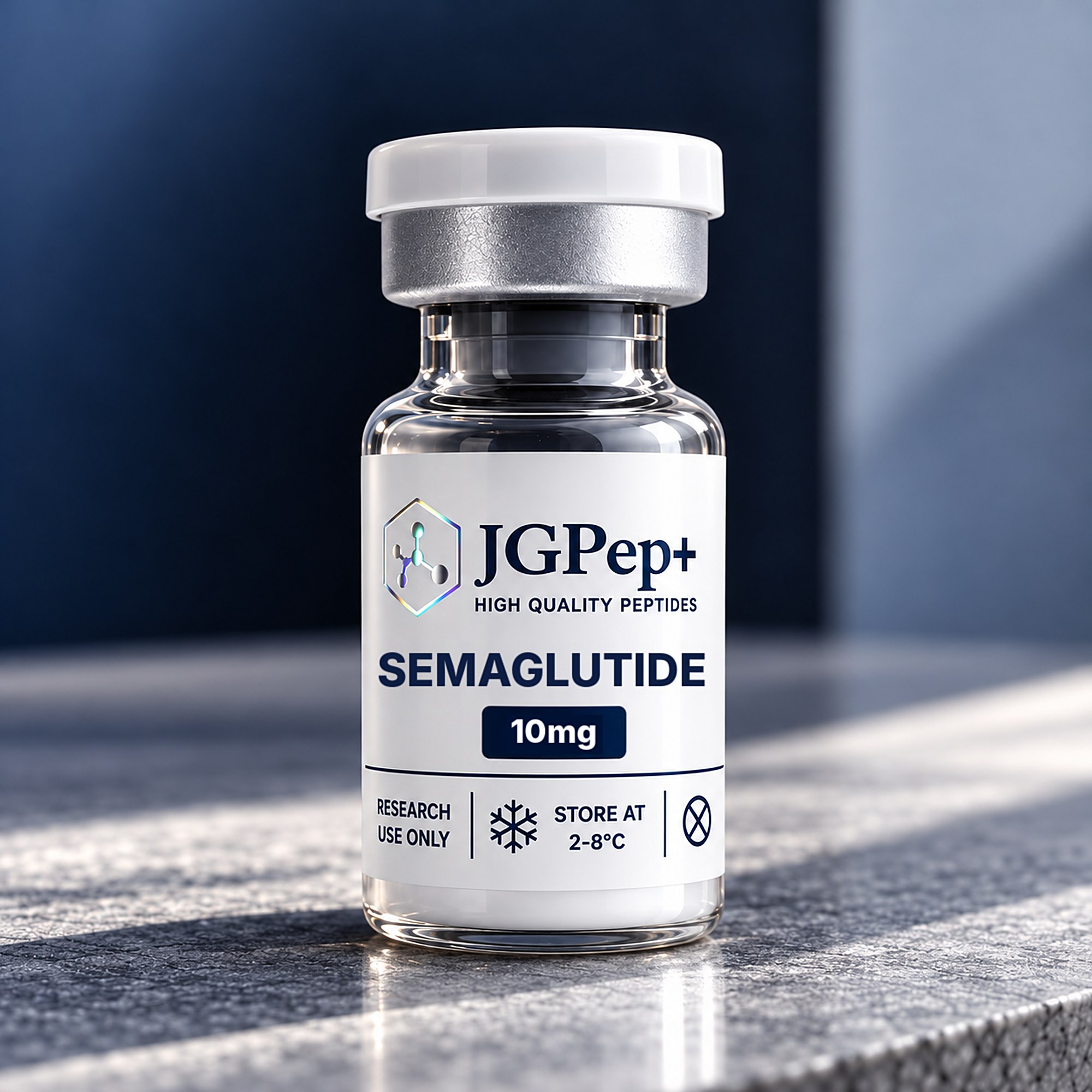
Semaglutide 10 mg — product details
This listing is for Semaglutide 10 mg, product code JG-MIG-007. The 10 mg figure is the listed material quantity, not a recommended dose or a concentration. Review this strength’s label and matching batch record when planning a laboratory assay.
LISTED CONTENT
10 mg
PRODUCT CODE
JG-MIG-007
INTENDED USE
Laboratory research
Research focus and areas of interest
Molecular design and exposure
The discovery paper describes changes to the GLP-1 scaffold, albumin interaction and resistance to metabolic breakdown. These are properties evaluated for defined experimental preparations. They do not establish a shelf life or storage condition for every product bearing the compound name. [1]
Neural-pathway experiments
Rodent studies investigated access to particular brain regions, receptor-associated responses and feeding-related neural circuits. Such experiments contribute mechanistic hypotheses, but animal-pathway findings should not be presented as direct evidence for an individual human outcome. [2]
Clinical comparisons and follow-up
SUSTAIN and STEP studies used defined populations and comparators, while SELECT analyses examined longer-term outcomes in another population. The formulation, eligibility criteria and endpoint definition should remain attached to each result. [3]
Evidence and limitations
The cited pharmaceutical studies do not validate this research vial for human use or establish equivalence with a regulated medicine. Molecular stability, clinical exposure and product storage stability are different questions and require different evidence.
Scientific references describe the material and methods used by their authors. They do not certify this product’s purity, sterility, identity or suitability for a particular experiment. A related analogue, delivery system or combination is not automatically equivalent to the supplied peptide.
Technical identity and documentation
Literature identity: a modified GLP-1 analogue with sequence substitutions and a derivatised lysine side chain. Confirm the precise chemical structure and batch identity; do not infer purity, validated bioactivity or pharmaceutical quality from the discovery literature.
For this product’s identity and batch results, visit the COA and documentation page or contact JGPEP+ with the product and batch numbers. Literature values should not replace a matching analytical certificate.
Storage and laboratory handling
Follow the product label and batch-specific supplier instructions. Confirm temperature, solvent compatibility, stability and any reconstitution requirements before use. Storage conditions reported for another supplier or a clinical formulation should not be applied automatically to this material.
Research references
Original studies and analytical papers are linked below. Study type is included so that laboratory models, clinical research and related-analogue evidence can be distinguished.
1. Discovery and structural design. Lau J et al. 2015 Sep 24. Journal of medicinal chemistry. Medicinal-chemistry and preclinical study. PubMed PMID 26308095 · Publisher / DOI
2. Rodent neural-pathway experiments. Gabery S et al. 2020 Mar 26. JCI insight. Animal mechanism study. PubMed PMID 32213703 · Publisher / DOI
3. Controlled STEP-2 clinical investigation. Davies M et al. 2021 Mar 13. Lancet (London, England). Randomised clinical trial. PubMed PMID 33667417 · Publisher / DOI
4. Head-to-head SUSTAIN-7 study. Pratley RE et al. 2018 Apr. The lancet. Diabetes & endocrinology. Randomised clinical trial. PubMed PMID 29397376 · Publisher / DOI
5. Longer-term SELECT analysis. Ryan DH et al. 2024 Jul. Nature medicine. Prespecified clinical-trial analysis. PubMed PMID 38740993 · Publisher / DOI
For laboratory research only. Not for human or veterinary consumption or administration. This information is scientific background, not medical advice or an administration guide.

Reviews
There are no reviews yet.