
RESEARCH OVERVIEW
What is TB-500?
TB-500 is a name used in peptide research and analytical literature, but it is not a sufficiently precise chemical identity on its own. Published work includes an N-acetylated thymosin-beta-4 fragment, other materials marketed under similar names, and engineered delivery systems. A sound TB-500 research overview begins by establishing which molecule was actually studied.
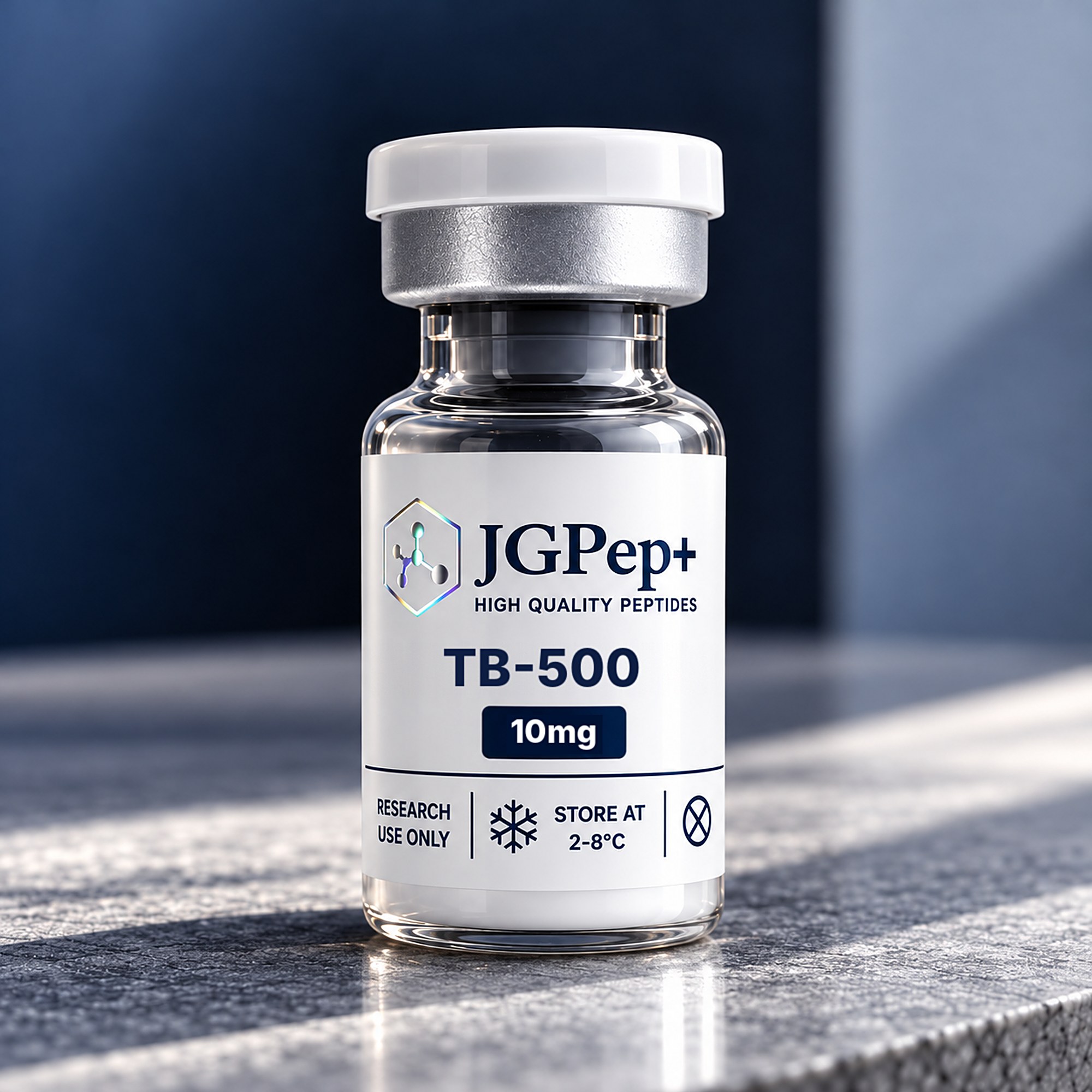
TB-500 10 mg — product details
This listing is for TB-500 10 mg, product code JG-MIG-018. The 10 mg figure is the listed material quantity, not a recommended dose or a concentration. Review this strength’s label and matching batch record when planning a laboratory assay.
LISTED CONTENT
10 mg
PRODUCT CODE
JG-MIG-018
INTENDED USE
Laboratory research
Research focus and areas of interest
Sequence identity comes first
An analysis of online products found that materials sold as TB500 or TB1000 did not consistently match prior descriptions. This makes the sequence, terminal modifications and analytical identity central to interpreting the literature. Full-length thymosin beta-4 should not automatically be equated with a shorter fragment. [1]
Analytical detection and metabolism
Mass-spectrometric studies examine how small peptides and their breakdown products can be extracted and detected. In vitro metabolism work includes liver preparations and serum, while an equine study examined N-acetylated LKKTETQ. These papers concern chemical identification and detectability rather than proof of a therapeutic effect. [3]
Formulation-specific tissue research
A recent corneal study incorporated a TB500-related sequence into an enzyme-responsive hydrogel. The hydrogel’s scaffold, assembly chemistry and local delivery are integral to that experiment. Results from such an engineered material cannot be assigned to an unformulated vial on the basis of a shared peptide name. [5]
Evidence and limitations
This selection deliberately separates analytical methods from tissue-model experiments. It does not establish human efficacy, a validated human route of administration or equivalence among products marketed as TB-500. Confirm the exact supplied material before selecting an experimental comparison.
Scientific references describe the material and methods used by their authors. They do not certify this product’s purity, sterility, identity or suitability for a particular experiment. A related analogue, delivery system or combination is not automatically equivalent to the supplied peptide.
Technical identity and documentation
Identity checks should include full amino-acid sequence, acetylation or other terminal modifications, molecular identity and batch-specific analytical results. The literature’s N-acetylated fragment is a research identity, not an independently verified specification for this product.
For this product’s identity and batch results, visit the COA and documentation page or contact JGPEP+ with the product and batch numbers. Literature values should not replace a matching analytical certificate.
Storage and laboratory handling
Follow the product label and batch-specific supplier instructions. Confirm temperature, solvent compatibility, stability and any reconstitution requirements before use. Storage conditions reported for another supplier or a clinical formulation should not be applied automatically to this material.
Research references
Original studies and analytical papers are linked below. Study type is included so that laboratory models, clinical research and related-analogue evidence can be distinguished.
1. Identity differences among marketed peptide materials. Delcourt V et al. 2023 Apr. Drug testing and analysis. Analytical product study. PubMed PMID 36482504 · Publisher / DOI
2. Multi-peptide mass-spectrometric screening. Jing J et al. 2022 Aug 2. Journal of chromatography. A. Analytical methods study. PubMed PMID 35802965 · Publisher / DOI
3. In vitro peptide-metabolism models. Esposito S et al. 2015 Jan. Journal of peptide science : an official publication of the European Peptide Society. In vitro analytical study. PubMed PMID 25469748 · Publisher / DOI
4. Equine plasma detection of an acetylated fragment. Kwok WH et al. 2013 Mar. Analytical and bioanalytical chemistry. Equine analytical study. PubMed PMID 23318763 · Publisher / DOI
5. Engineered TB500-related corneal hydrogel. Lu P et al. 2025 Dec 17. ACS applied materials & interfaces. Engineered formulation study. PubMed PMID 41359360 · Publisher / DOI
For laboratory research only. Not for human or veterinary consumption or administration. This information is scientific background, not medical advice or an administration guide.

Reviews
There are no reviews yet.