
RESEARCH OVERVIEW
What is Tesamorelin?
Tesamorelin is a growth-hormone-releasing-hormone analogue examined in endocrine, metabolic and liver-related research. Published studies include controlled clinical trials and analyses of biological samples collected in defined patient populations. The literature concerns specific study formulations and must be distinguished from this laboratory research product.
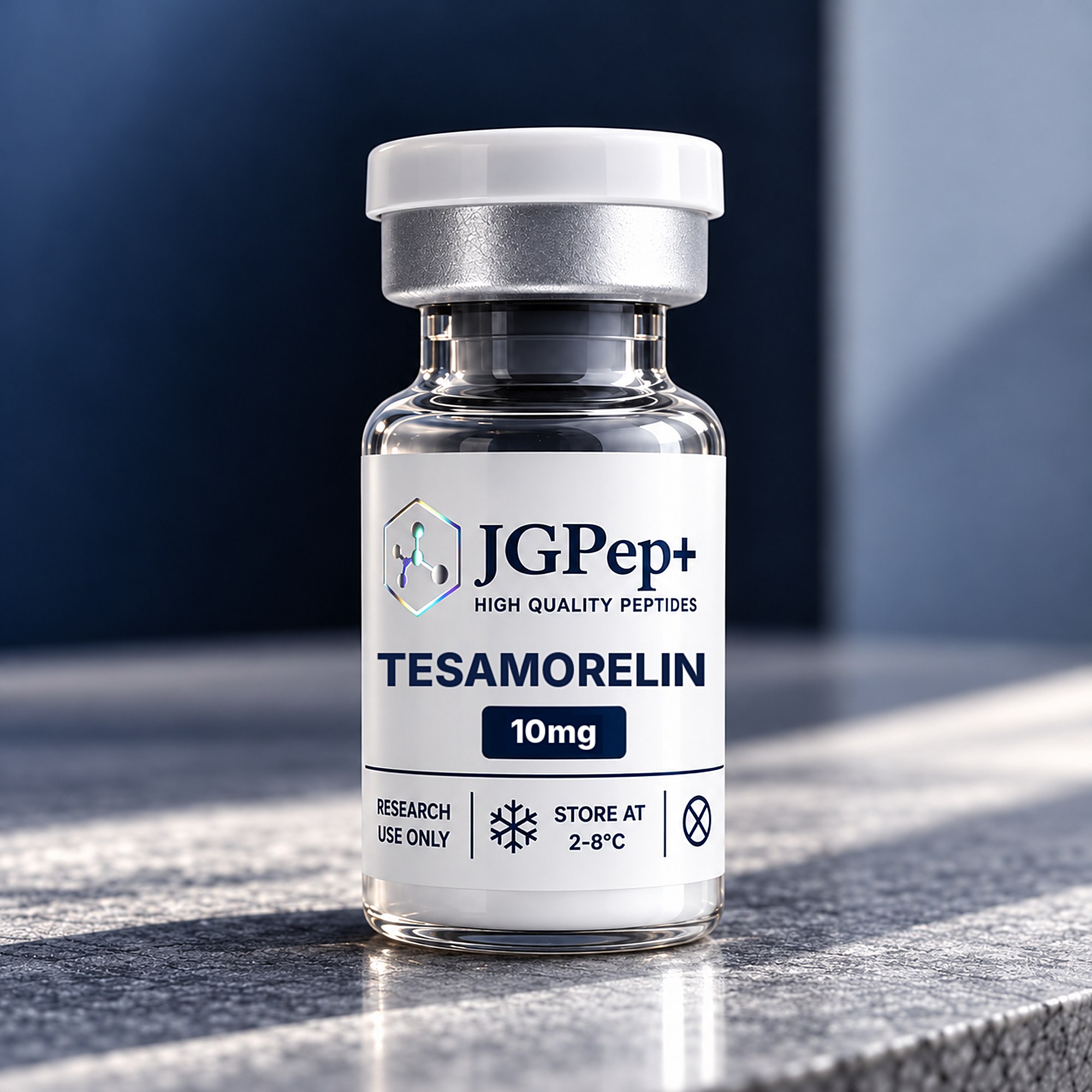
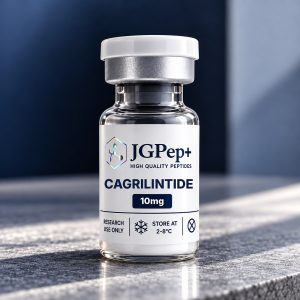
Tesamorelin 10 mg — product details
This listing is for Tesamorelin 10 mg, product code JG-MIG-031. The 10 mg figure is the listed material quantity, not a recommended dose or a concentration. Review this strength’s label and matching batch record when planning a laboratory assay.
LISTED CONTENT
10 mg
PRODUCT CODE
JG-MIG-031
INTENDED USE
Laboratory research
Research focus and areas of interest
Endocrine and body-composition endpoints
Investigators have assessed visceral adipose tissue, circulating markers and related physiological measurements in selected populations. These endpoints address the GH–IGF axis under a clinical protocol rather than supporting a universal body-composition claim. [1]
Study populations and safety measurements
Separate trials enrolled people with HIV-associated abdominal fat accumulation or type 2 diabetes. Differences in participant selection and monitoring matter. A finding in one population should not be represented as evidence of equivalent safety or effectiveness in another. [2]
Hepatic tissue and gene-expression research
A liver-focused trial and an analysis of paired liver samples examined fat content, tissue findings and transcriptomic pathways. The molecular analysis provides hypotheses about biological responses, while the clinical trial provides population-specific outcomes. [4]
Evidence and limitations
The references include clinical trials and a tissue-based analysis rather than a validation of this supplied batch. They do not support self-treatment instructions, a guarantee of safety or substitution for a prescribed pharmaceutical preparation.
Scientific references describe the material and methods used by their authors. They do not certify this product’s purity, sterility, identity or suitability for a particular experiment. A related analogue, delivery system or combination is not automatically equivalent to the supplied peptide.
Technical identity and documentation
Literature identity: a modified GHRH(1-44)-related peptide. Confirm sequence, chemical modifications, counterion and analytical content using product-specific documentation. No manufacturing source or product shelf life is established by the cited studies.
For this product’s identity and batch results, visit the COA and documentation page or contact JGPEP+ with the product and batch numbers. Literature values should not replace a matching analytical certificate.
Other listed quantities
These are separate catalogue quantities, not a dosing ladder. The research literature concerns the peptide or specified study formulation rather than a claim that one catalogue strength is more effective.
Storage and laboratory handling
Follow the product label and batch-specific supplier instructions. Confirm temperature, solvent compatibility, stability and any reconstitution requirements before use. Storage conditions reported for another supplier or a clinical formulation should not be applied automatically to this material.
Research references
Original studies and analytical papers are linked below. Study type is included so that laboratory models, clinical research and related-analogue evidence can be distinguished.
1. Endocrine and metabolic controlled study. Makimura H et al. 2012 Dec. The Journal of clinical endocrinology and metabolism. Randomised clinical trial. PubMed PMID 23015655 · Publisher / DOI
2. Clinical study with a safety-extension phase. Falutz J et al. 2010 Mar. Journal of acquired immune deficiency syndromes (1999). Randomised clinical trial. PubMed PMID 20101189 · Publisher / DOI
3. Glucose-control and safety measurements. Clemmons DR et al. 2017. PloS one. Randomised clinical trial. PubMed PMID 28617838 · Publisher / DOI
4. Hepatic transcriptomic analysis. Fourman LT et al. 2020 Aug 20. JCI insight. Clinical tissue-analysis study. PubMed PMID 32701508 · Publisher / DOI
5. Randomised liver-fat study. Stanley TL et al. 2019 Dec. The lancet. HIV. Randomised clinical trial. PubMed PMID 31611038 · Publisher / DOI
For laboratory research only. Not for human or veterinary consumption or administration. This information is scientific background, not medical advice or an administration guide.

Reviews
There are no reviews yet.