
RESEARCH OVERVIEW
What is Tirzepatide?
Tirzepatide is a peptide studied for combined GIP- and GLP-1-receptor agonism. Its literature includes clinical comparisons, metabolic biomarker analyses and longer-term follow-up. These studies concern pharmaceutical preparations used under defined protocols; they should not be used to imply clinical equivalence of a laboratory research product.
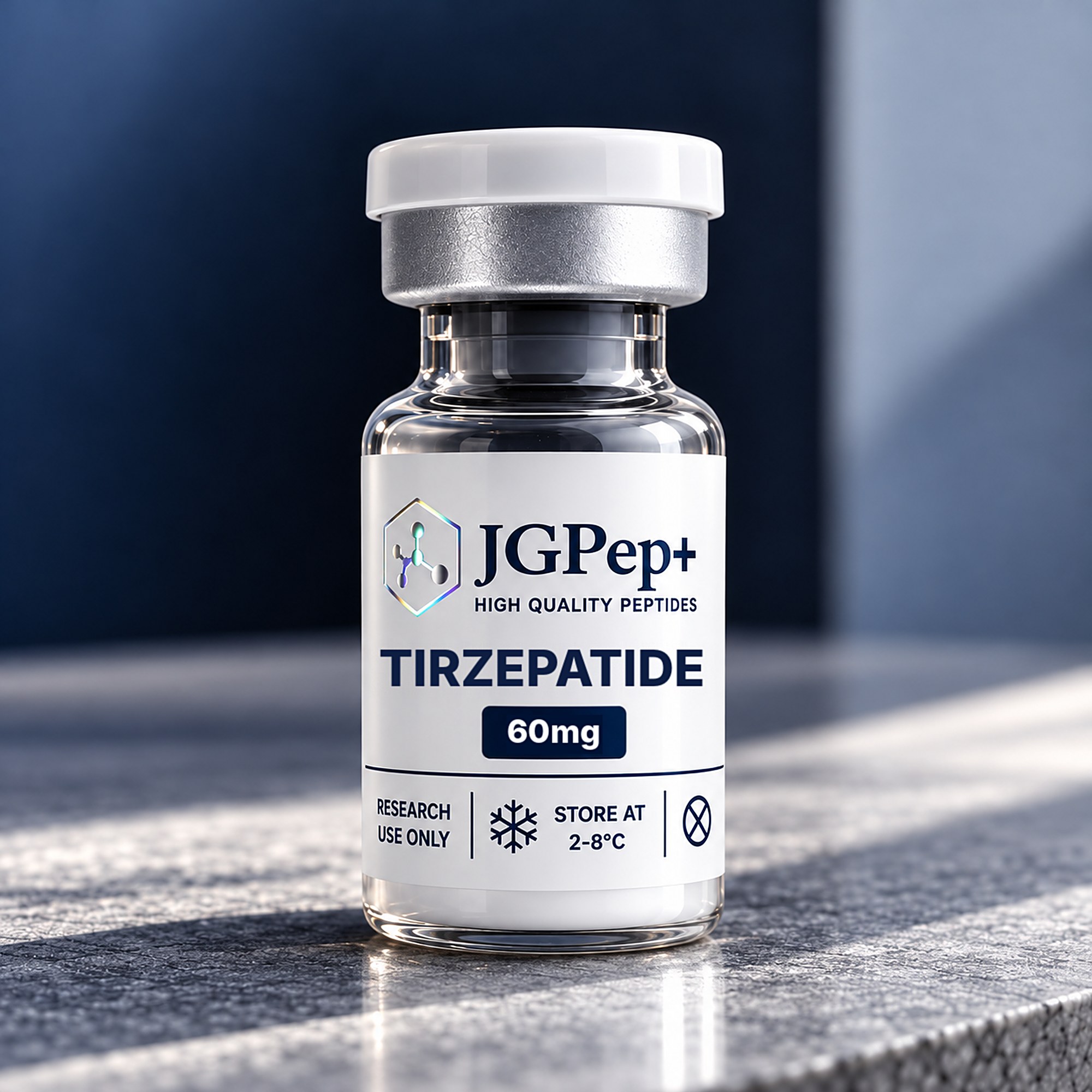
Tirzepatide 60 mg — product details
This listing is for Tirzepatide 60 mg, product code JG-MIG-016. The 60 mg figure is the listed material quantity, not a recommended dose or a concentration. Review this strength’s label and matching batch record when planning a laboratory assay.
LISTED CONTENT
60 mg
PRODUCT CODE
JG-MIG-016
INTENDED USE
Laboratory research
Research focus and areas of interest
Dual-incretin research
GIP and GLP-1 are distinct incretin signalling systems. Tirzepatide research explores their combined engagement, but clinical endpoints reflect the integrated response of a population rather than a direct assay of each receptor’s contribution. [1]
Comparative clinical studies
A head-to-head trial compared tirzepatide with semaglutide in a specified type-2-diabetes population. A separate obesity study used a different design and participant group. Comparisons across trials should account for these differences instead of ranking compounds from headline results alone. [2]
Biomarkers and longer-term follow-up
Analyses of beta-cell-function and insulin-sensitivity markers address possible mechanisms, while longer follow-up examines persistence of outcomes and safety reporting. Secondary analyses can support hypotheses without proving that one mechanism explains every clinical effect. [3]
Evidence and limitations
The references do not demonstrate that this JGPEP+ preparation is a prescribed medicine or an equivalent substitute. Identity, formulation, manufacturing controls and clinical monitoring are separate from the presence of the same compound name.
Scientific references describe the material and methods used by their authors. They do not certify this product’s purity, sterility, identity or suitability for a particular experiment. A related analogue, delivery system or combination is not automatically equivalent to the supplied peptide.
Technical identity and documentation
Literature identity: a peptide dual GIP/GLP-1-receptor agonist. Confirm exact molecular identity, chemical modifications, counterion and analytical content for the supplied batch. Listed milligrams describe quantity, not an administration schedule.
For this product’s identity and batch results, visit the COA and documentation page or contact JGPEP+ with the product and batch numbers. Literature values should not replace a matching analytical certificate.
Other listed quantities
These are separate catalogue quantities, not a dosing ladder. The research literature concerns the peptide or specified study formulation rather than a claim that one catalogue strength is more effective.
Storage and laboratory handling
Follow the product label and batch-specific supplier instructions. Confirm temperature, solvent compatibility, stability and any reconstitution requirements before use. Storage conditions reported for another supplier or a clinical formulation should not be applied automatically to this material.
Research references
Original studies and analytical papers are linked below. Study type is included so that laboratory models, clinical research and related-analogue evidence can be distinguished.
1. Controlled obesity study. Jastreboff AM et al. 2022 Jul 21. The New England journal of medicine. Randomised clinical trial. PubMed PMID 35658024 · Publisher / DOI
2. Head-to-head comparison in type-2 diabetes. Frías JP et al. 2021 Aug 5. The New England journal of medicine. Randomised clinical trial. PubMed PMID 34170647 · Publisher / DOI
3. Beta-cell and insulin-sensitivity biomarker analysis. Thomas MK et al. 2021 Jan 23. The Journal of clinical endocrinology and metabolism. Secondary clinical-trial analysis. PubMed PMID 33236115 · Publisher / DOI
4. Longer-term clinical follow-up. Jastreboff AM et al. 2025 Mar 6. The New England journal of medicine. Randomised-trial follow-up. PubMed PMID 39536238 · Publisher / DOI
5. Later direct comparator clinical study. Aronne LJ et al. 2025 Jul 3. The New England journal of medicine. Randomised clinical trial. PubMed PMID 40353578 · Publisher / DOI
For laboratory research only. Not for human or veterinary consumption or administration. This information is scientific background, not medical advice or an administration guide.

Reviews
There are no reviews yet.