RESEARCH OVERVIEW
What is Cagrilintide?
Cagrilintide is a modified, lipidated amylin analogue studied in peptide medicinal chemistry and clinical development. The literature covers molecular design, pharmacokinetics and physiological endpoints. Some studies examine cagrilintide alone; others evaluate its combination with semaglutide, so the evidence must be separated by formulation.
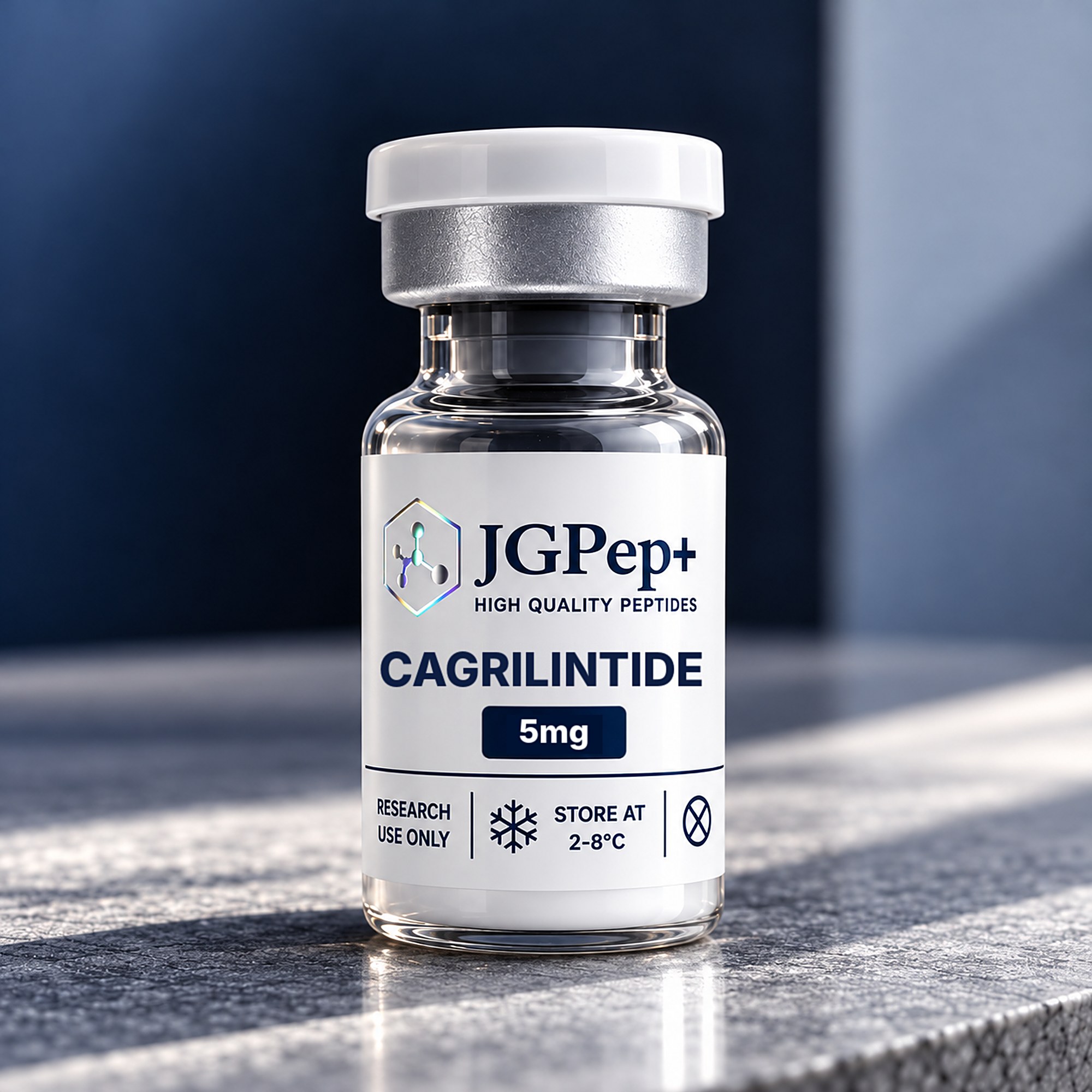
Cagrilintide 5 mg — product details
This listing is for Cagrilintide 5 mg, product code JG-MIG-037. The 5 mg figure is the listed material quantity, not a recommended dose or a concentration. Review this strength’s label and matching batch record when planning a laboratory assay.
LISTED CONTENT
5 mg
PRODUCT CODE
JG-MIG-037
INTENDED USE
Laboratory research
Research focus and areas of interest
Amylin-analogue design
The compound-development paper discusses modifications intended to address properties of native amylin, including formulation and aggregation challenges. Structure–activity research helps explain why modifications were investigated, but does not supply an analytical specification for a separately manufactured research vial. [1]
Single-agent clinical research
A controlled dose-finding study investigated body-weight and safety endpoints using a clinical study preparation. Such a trial describes a defined protocol, population and monitored product; its findings are not a claim that this catalogue item is a licensed medicine or has equivalent performance. [2]
Combination studies
Phase 1b, phase 2 and later trials assessed cagrilintide with semaglutide. These references are included as combination research. Their results should not be attributed to cagrilintide alone, to a different mixture, or to material without equivalent identity and formulation. [3]
Evidence and limitations
The linked papers include medicinal chemistry and human trials. Trial outcomes depend on the specified pharmaceutical preparations and controlled protocols. They do not establish the safety, suitability or efficacy of this JGPEP+ research material for human or veterinary use.
Scientific references describe the material and methods used by their authors. They do not certify this product’s purity, sterility, identity or suitability for a particular experiment. A related analogue, delivery system or combination is not automatically equivalent to the supplied peptide.
Technical identity and documentation
Literature identity: a lipidated amylin analogue. Confirm exact molecular identity, acylation, counterion and analytical results for the supplied batch. The listed quantity does not specify concentration or constitute a clinical dose.
For this product’s identity and batch results, visit the COA and documentation page or contact JGPEP+ with the product and batch numbers. Literature values should not replace a matching analytical certificate.
Other listed quantities
These are separate catalogue quantities, not a dosing ladder. The research literature concerns the peptide or specified study formulation rather than a claim that one catalogue strength is more effective.
Storage and laboratory handling
Follow the product label and batch-specific supplier instructions. Confirm temperature, solvent compatibility, stability and any reconstitution requirements before use. Storage conditions reported for another supplier or a clinical formulation should not be applied automatically to this material.
Research references
Original studies and analytical papers are linked below. Study type is included so that laboratory models, clinical research and related-analogue evidence can be distinguished.
1. Molecular design of the amylin analogue. Kruse T et al. 2021 Aug 12. Journal of medicinal chemistry. Medicinal-chemistry study. PubMed PMID 34288673 · Publisher / DOI
2. Controlled single-agent clinical study. Lau DCW et al. 2021 Dec 11. Lancet (London, England). Randomised clinical trial. PubMed PMID 34798060 · Publisher / DOI
3. Early combination study with semaglutide. Enebo LB et al. 2021 May 8. Lancet (London, England). Combination clinical trial. PubMed PMID 33894838 · Publisher / DOI
4. Phase 2 combination research. Frias JP et al. 2023 Aug 26. Lancet (London, England). Combination clinical trial. PubMed PMID 37364590 · Publisher / DOI
5. Later combination trial with active comparators. Garvey WT et al. 2025 Aug 14. The New England journal of medicine. Combination clinical trial. PubMed PMID 40544433 · Publisher / DOI
For laboratory research only. Not for human or veterinary consumption or administration. This information is scientific background, not medical advice or an administration guide.

Reviews
There are no reviews yet.